SRF:
A capacitor doesn’t always behave like a capacitor, especially at high frequencies. As shown below, the equivalent circuit of a capacitor includes a series inductance, known as the Equivalent Series Inductance (ESL). The ESL varies depending on the capacitor type, packaging, and physical dimensions.
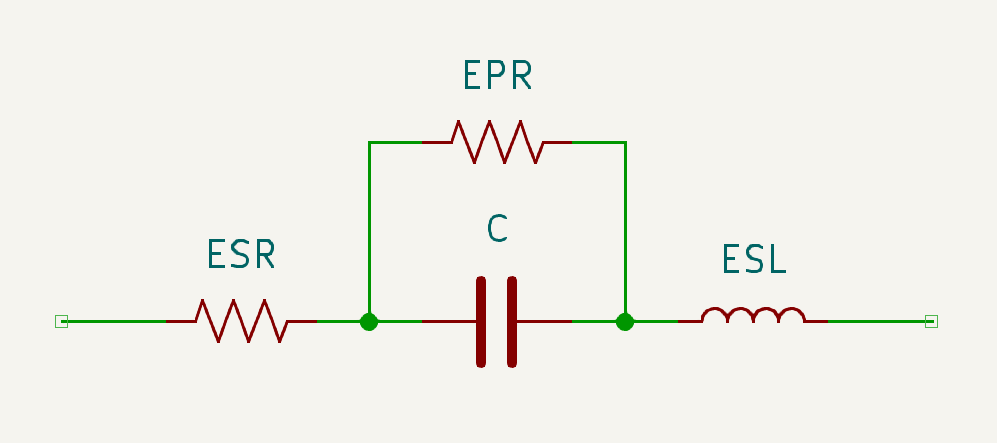
At low frequencies, the impedance of the ESL (ZL) is negligible compared to the impedance of the capacitor (ZC):
As the frequency increases, ZL increases while ZC decreases. At high frequencies, the inductive impedance dominates, causing the capacitor to act more like an inductor. But what do we mean by “low frequency” and “high frequency”? How can they be distinguished?
At a specific frequency, the two impedances ZL and ZC become equal. This is known as the self-resonant frequency (SRF) of the capacitor:
Larger capacitors tend to have a lower SRF. This is why, in some cases, you may see a nano-Farad capacitor placed in parallel with a multi-micro-Farad capacitor. The smaller capacitor is used to maintain capacitive behavior at higher frequencies where the larger capacitor cannot.

Leave a comment